

There are weeks when the books arrive faster than I or the discourse can catch up to them. This is one of those weeks. Three writers I read closely & trust have published books inside the same 8-day window. Two are about the wellness industry—what it became, who it serves, what it has trained an entire generation to ignore. The third is about how to talk to your kids about fascism. Here is why each of them matters.
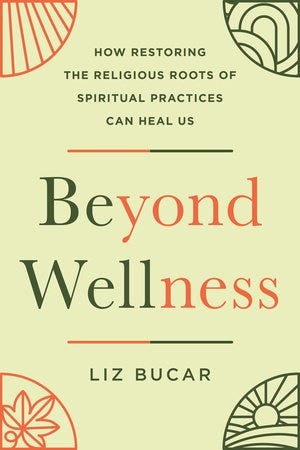
Beyond Wellness: How Restoring the Religious Roots of Spiritual Practices Can Heal Us by Liz Bucar (Tarcher, out today)
Liz is a religious ethics scholar at Northeastern. I have been reading her for a while—she is the rare academic who can move between TikTok and a 250-page book without losing rigor in either direction, and her last book, Stealing My Religion, is one of the more useful things written this decade on appropriation.
Beyond Wellness takes seven practices that have been pulled out of religious traditions and repackaged as self-care—yoga, meditation, sound baths, psychedelics, detox diets, and a few more — and asks a question the wellness industry will not: what do these practices actually do once you strip out the ethical frameworks and communal obligations they came embedded in? Her answer is uncomfortable for almost everyone. The practices were never designed to optimize the self. They were designed to bind the self to other people.
I wrote about a sentence from one of her recent essays back in December—when spirituality stops binding us to each other, it starts binding us to blame—and I reference it often, still. The book is the longer argument underneath that sentence. Read it because it explains, with care and without contempt, why the salad bar approach to spiritual practice keeps producing people who cannot tell the difference between transformation and harm.
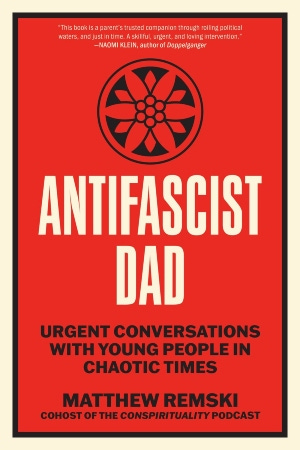
Antifascist Dad: Urgent Conversations with Young People in Chaotic Times by matthew remski (North Atlantic Books, April 2026)
Matthew is one of the three co-hosts of the Conspirituality podcast, where I guested in 2021 to talk about my work with João de Deus. He is also a former member of two cults, which informs everything he writes—including this book, which is structured as twelve conversations parents can have with their kids about why fascism feels seductive and what to offer instead.
I am reading this one as the mother of a twenty-one-year-old son who is an avid gamer. This is not incidental context! He is exactly the demographic the algorithm is hunting—the kids who spend hours a day in voice chat, on Discord, inside platforms where manosphere content is one click and one frustrated session away. I do not assume my kid is being radicalized. I also do not assume he is not being marketed to, constantly, by people who understand his vulnerabilities and attention span better than most parents do.
What Matthew offers is something most of the parenting discourse has refused to: he treats young men as people being acted upon by a system, not as a problem to be managed. He has been mapping the wellness-to-MAGA pipeline since 2020, and Antifascist Dad is where the mapping work meets the question of what to actually do—at the kitchen table (if you can get them to leave their room), in the car, in the middle of a conversation that is already harder than you wanted it to be.
The structural insight at the center of the book is one I keep coming back to here on substack: authoritarian movements and high-control wellness communities run on the same operating system, where charisma replaces competence, belonging is conditional, and dissent is pathologized.

Well Enough: Finding Health Despite the Wellness Industry by Derek Beres (Tempo Books, April 20, 2026)
Derek is also a Conspirituality co-host, and Well Enough is the most personal book any of the three of them has written. He spent decades teaching yoga and group fitness in New York and Los Angeles. He worked in an emergency room. He lived inside a fifteen-year struggle with disordered eating that the wellness industry actively reinforced—through clean-eating rituals, macronutrient tracking, the slow conversion of food into a moral category.
From the book's framing and the excerpts he has been publishing on his Substack ahead of the release, the memoir tracks how an industry that promised holistic health became a trillion-dollar purity hustle, and how Covid accelerated the conversion of that hustle into political danger. The chapter he ran on his fifteen-year struggle with disordered eating is the kind of writing the wellness industry almost never allows—partly because so much of its revenue depends on the line between aspiration and orthorexia staying blurry. I am looking forward to reading the full book.
A note on what these three books do together. Liz gives you the theological diagnosis—what was lost when the practices were severed from their traditions. Matthew gives you the political stakes—what fills the vacuum when meaning becomes a marketplace. Derek gives you the body count—what it does to a person to live inside the marketplace for long enough.
I don’t think it’s accidental that all three arrived in the same week. The conversation around wellness has finally broken into the mainstream, catching up to what people within it have been saying for years. Matthew’s book doesn’t belong to that conversation so much as it runs alongside it—concerned with a different, but related, set of pressures shaping how people think and believe.
Read them in any order. Then lend them to someone who still thinks any of this is mostly harmless.
catalyst is a free newsletter. No paid tiers, no ads, no cross-promotion. If you found this useful, the most helpful thing you can do is share it with one person who needs it.
Thank you Lisa!