

Frontloading: I want to be careful about what I’m claiming here, because the Epstein files make carefulness hard. The scale of the document releases—3.5 million pages from the DOJ alone, plus the House Oversight materials from late 2025—creates a kind of name-vertigo. Everyone is in there. Everyone is adjacent to something. And the temptation, especially now, is to treat mention as meaning.
So let me be precise about what I’m actually arguing.
This isn’t a piece about whether the physicists who attended a 2006 conference on St. Thomas knew what Jeffrey Epstein was. It’s a piece about what Epstein understood about physics—specifically, about how prestige works in elite science, and how efficiently someone with money and ambition and no actual scientific training could insert himself into it. That’s a structural story. And it’s one the physics community hasn’t fully reckoned with.
I’m not a physicist, but I’m not a complete outsider to this world either. I spent years working on books on quantum and theoretical physics—close enough to the ideas to understand what the field values, close enough to the publishing machinery to understand how that value gets constructed and sold. That dual vantage point is why this story interests me. I know how prestige works in the industry that packages physics for public consumption. And I recognize the architecture Epstein was exploiting.
What Epstein Was Actually Buying
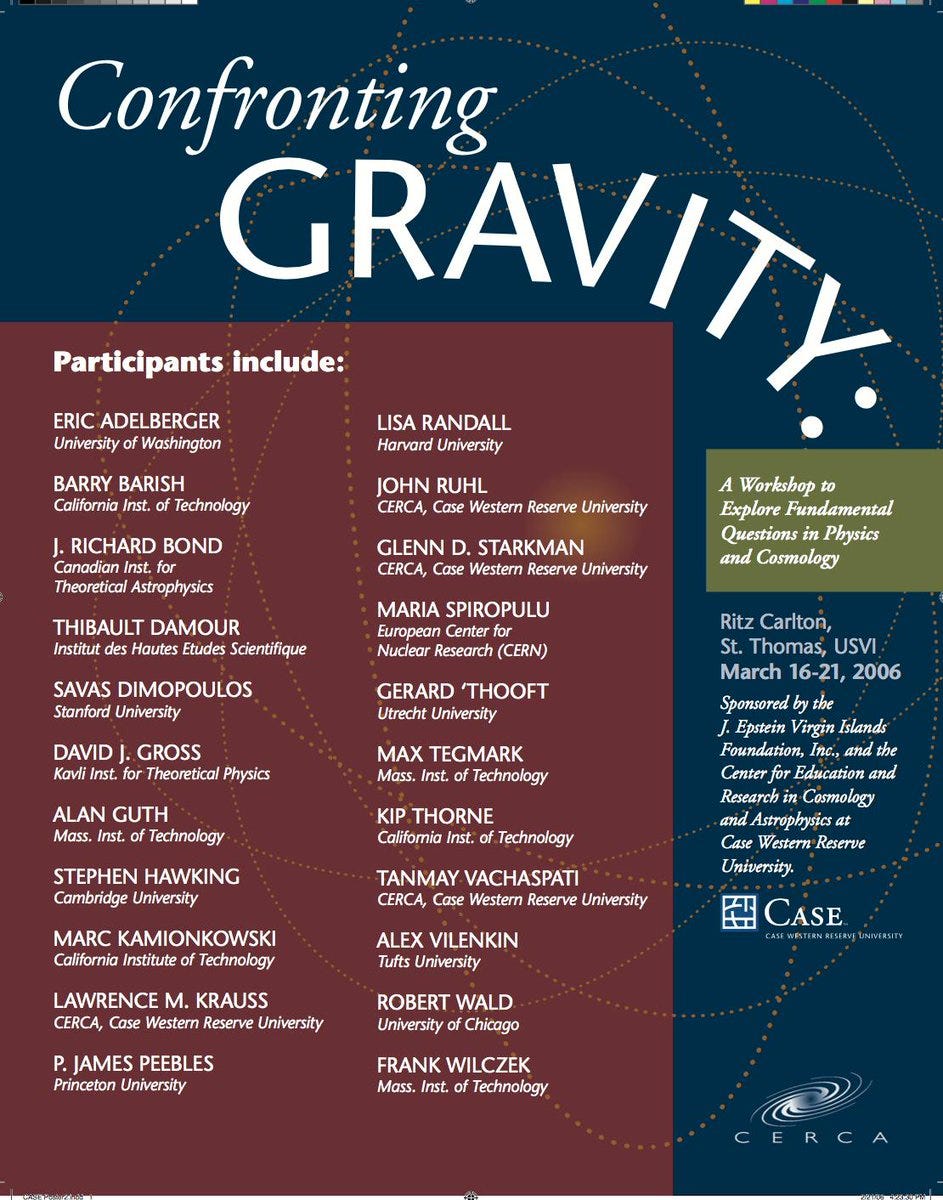
In March 2006, roughly twenty of the world’s most distinguished physicists gathered at a resort on St. Thomas for a private workshop called Confronting Gravity: A Workshop to Explore Fundamental Questions in Physics and Cosmology. The event was coordinated by Lawrence Krauss, the theoretical physicist and science popularizer then at Case Western Reserve University. It was sponsored by the J. Epstein Virgin Islands Foundation and underwritten, per contemporaneous local reporting, by Epstein himself, who was described as the driving force behind the gathering.
Among those present: Stephen Hawking. Frank Wilczek, Nobel laureate. David Gross, Nobel laureate. Gerard ‘t Hooft, Nobel laureate. The workshop covered gravitational waves, black holes, the reconciliation of quantum mechanics and general relativity.
This was not a vanity event. The science was serious. The people were serious. And that’s exactly the point.
Epstein wasn’t trying to do physics. He was trying to become the person who convened physics. There’s a distinction there that matters. The guru economy I’ve watched for decades works the same way—what’s being purchased isn’t expertise, it’s adjacency. The appearance of being the kind of person who belongs in the room where important things happen.
What does that cost? In Epstein’s case: a conference center, travel, a few days on a Caribbean island for people who could have found other funding if they’d looked. He got his name attached to a gathering that included three Nobel laureates and the most famous physicist alive. He got to be quoted in local press about freeing great minds from distraction. He got to describe himself as someone who cared about the deepest questions in science.
That’s a remarkably cheap way to build a credential.
The workshop also included public outreach components—a lecture at the University of the Virgin Islands, talks to high school students—that let Epstein’s foundation present itself as a civic actor. So the Nobel laureates became, in a sense, part of his philanthropic brand. They didn’t sign up for that. But they didn’t refuse it either, and there’s something worth sitting with in that.
And then there’s Krauss.
Krauss is the figure in this story who most rewards attention, because his role wasn’t just organizational. He was, at the time, one of the most visible science communicators in the world—a bestselling author, a tireless public advocate for physics and scientific skepticism, someone whose brand was built on the idea that science could and should be brought to a general audience. That made him unusually valuable to Epstein, and unusually vulnerable to what Epstein was offering.
The relationship extended well beyond St. Thomas. At Arizona State University, where Krauss later built the Origins Project—a high-profile public science platform hosting lectures, debates, and large-scale events—Epstein’s money followed. Reporting places roughly $250,000 in donations from Epstein’s Enhanced Education vehicle into that effort. The Origins Project was exactly the kind of enterprise Epstein liked to fund: prestigious, public-facing, attached to a recognizable name, and positioned at the intersection of serious science and popular culture. It wasn’t a research lab. It was a legitimacy engine. And Epstein, through Krauss, had a stake in it.
I’ve worked in PR and publishing long enough to understand what that kind of relationship looks like from the inside. I know the world Krauss inhabited—the ecosystem where serious science meets trade publishing, where ideas get packaged for general audiences, where a communicator’s platform is simultaneously an intellectual project and a commercial one. When someone appears in that world who is enthusiastic, well-resourced, and apparently serious about ideas, that’s not an obvious red flag. It’s an apparently useful relationship. The question that doesn’t get asked often enough—in physics or in wellness or anywhere else—is: what does this person get from being attached to me? What am I providing that they can’t buy more directly?
In Krauss’s case, what Epstein got was proximity to the most credible register of science communication—not just the research, but the public translation of it. A donor who funds a physics workshop gets a footnote. A donor who funds the platform where physics meets the public gets something closer to a co-author credit on the culture.
Krauss has maintained that his relationship with Epstein was professional and philanthropic. The Nature files reporting adds one more detail that complicates that framing: in 2018, as Krauss faced a sexual misconduct investigation that led to his ousting from Arizona State, he reached out to Epstein for advice on how to respond. Epstein’s reply—“I thought we agreed no comment !!!!!”—is its own kind of document. Two men, each managing reputational crises connected to the treatment of women, coordinating their silence. That’s not philanthropy. That’s something else.
Brian Greene and the World Science Festival
Brian Greene is, by any measure, the most successful physics communicator of his generation. The Elegant Universe. The Fabric of the Cosmos. The Hidden Reality. PBS miniseries. Sold-out public lectures. The World Science Festival, which he co-founded in 2008 and chairs, is probably the most ambitious attempt in recent memory to bring serious physics to a general audience. It is also, it turns out, where his connection to Epstein is rooted. I fangirl hard for Brian Greene.
Documents released by the DOJ show Greene maintained contact with Epstein between at least 2010 and 2012—two to four years after Epstein’s conviction. The emails show Greene inviting Epstein to events at the 2012 World Science Festival, personally saving tickets to the opening gala and his conference program on quantum mechanics, and exchanging friendly messages about getting together. In a December 2011 email, Greene replied to an Epstein message about seeing each other again, writing that it would be “fun to hang out.” Epstein had previously donated $100,000 to the festival in 2007; the festival says it declined further support in 2012.
A May 2012 email shows Greene connecting Epstein with other scientists for what appears to have been a gathering at Epstein’s home. A separate Epstein email lists a dinner that would include Greene, Woody Allen, and Lawrence Krauss—the same Krauss who had been coordinating Epstein-funded physics events six years earlier. Groff’s correspondence notes that Epstein had tentatively planned to depart for his private island after the dinner. Greene ultimately couldn’t attend due to a scheduling conflict with the festival itself.
When the documents surfaced this February, Greene issued a statement to the Columbia Daily Spectator: “In my efforts to support the success of the World Science Festival, I had contact with Jeffrey Epstein on a few occasions over a period of years. I deeply regret any contact that we had.”
That’s a real apology, and it matters. Greene named the mechanism himself: he was trying to fund an institution, not seeking personal enrichment. Not, as far as the record shows, seeking anything beyond financial support for a festival dedicated to exactly the kind of science communication Epstein claimed to care about. And Epstein, once again, was in the right place with a checkbook and an enthusiasm for being in the room.
The World Science Festival is the most visible public platform for physics in America. Epstein’s name was on its donor list. His name sat alongside the most distinguished scientists alive. He understood exactly what that was worth—and it wasn’t the $100,000.
The Patterns I Recognize As A PR Person
I’ve watched charismatic figures manufacture proximity their entire careers. The mechanism is consistent: find the most credentialed people in a field, engineer a context in which you are the one facilitating their gathering, and let the reflected prestige do its work. You don’t need to be the smartest person in the room. You just need to be the one who booked the room.
What made Epstein unusually effective at this—and what the documents now make clearer—is that he did it across fields simultaneously, and he maintained the relationships over years. The 2006 St. Thomas workshop wasn’t a one-time event. It was infrastructure. It was a node in a network he kept building.
At MIT, that network ran directly through Seth Lloyd, a quantum physicist whose research Epstein funded through at least ten gifts totaling $850,000 between 2002 and 2017—a span that includes the years after Epstein’s 2008 Florida conviction. MIT’s independent investigation, one of the most detailed primary documents we have on any of this, alleges that Lloyd received a personal gift of $60,000 that went directly to his personal account and was never recorded by MIT. It also alleges that in 2012, Lloyd deliberately concealed Epstein’s identity as the source of certain donations. MIT subsequently imposed five-year restrictions on Lloyd’s compensation, advising, and donor solicitation privileges.
That’s not naïveté. That’s a pattern of poor choices.
At Harvard, the numbers are larger: $9.1 million in gifts between 1998 and 2008, including a $6.5 million gift that established the Program for Evolutionary Dynamics. Harvard officially stopped accepting Epstein’s money after his conviction. But Epstein visited the program’s offices more than forty times between 2010 and 2018. Forty times. He was using those visits to meet with, per Harvard’s own review, prominent faculty from the Cambridge area. The money had purchased something that outlasted the money.
The DOJ releases have also surfaced the name of Lisa Randall, a Harvard physicist widely regarded as one of the most important theorists of her generation. The files show her joking with Epstein about his house arrest in a 2010 email, visiting his private island in 2014, and maintaining contact into 2017. Randall told The Harvard Crimson: “I am appalled by the full extent of allegations against him and deeply regret maintaining contact.” She explained she first met Epstein in 2004 at a dinner hosted by her literary agent, John Brockman, who connected many scientists to Epstein. She attended the 2006 gravity conference he sponsored.
I don’t raise her name to indict her. I raise it because it’s part of a pattern that deserves honest accounting: Epstein wasn’t lurking at the margins of elite physics. He was, for years, inside it.
Lee Smolin is one of the founding faculty members of the Perimeter Institute for Theoretical Physics in Waterloo, Ontario—one of the most respected independent research centers in the world, known for serious work in quantum gravity and cosmology. His name appears 182 times in the DOJ files. In 2019, he told The Verge he had not been in contact with Epstein since 2008. The files show correspondence continuing until at least 2013. In one 2009 email—written while Epstein was still serving his Florida sentence, allowed out only during the day to work—Smolin wrote: ‘I hear that you are out and living there at home. Hope all is well, would love to see you and catch up at some point.’ Epstein replied offering to fly Smolin and his family to Florida. Smolin has not responded to press inquiries. At the institute’s request, he has agreed to pause his working relationship with Perimeter while a review is conducted.
The gap between what Smolin told reporters in 2019 and what the files show isn’t ambiguous. It’s not a matter of interpretation or missing context. He said one thing. The documents show another. That’s the detail that makes this different from the other cases in this piece — where the question is about judgment, or institutional failure, or the seductions of proximity. Here the question is simpler, and Smolin isn’t answering it.
Where Physics Met Wellness: The Chopra-UCSD Thread
I’ve written a lot about Deepak Chopra. Entirely too much, as I’ve noted before. But there’s a specific thread in the Epstein files that belongs in this piece, because it sits at the intersection of the two worlds I know well: the wellness and spirituality ecosystem, and the science and physics-adjacent spaces where scientific authority gets borrowed, packaged, and sold.
Documents from the DOJ releases show that Chopra served as a direct conduit for Epstein money into a University of California San Diego neuroscience lab. The recipient was V.S. Ramachandran, a prominent cognitive neuroscientist, who was studying what he described as an “autistic savant who displays telepathy.” In a 2017 email, Ramachandran told Chopra he had “no problem with my lab being funded by Epstein... so long as there’s no UC connection.” Epstein then directed a $25,000 grant from his Gratitude Foundation through his accountant, Richard Kahn, to the UC Board of Regents to fund the research. The check was FedExed the same day.
NPR found voice messages in the files of Chopra seeking Epstein’s financial guidance. The files show Epstein connecting Chopra to investment opportunities, brokering business deals, and facilitating access to political power—including, per the files, an event connected to the Saudi Crown Prince’s Silicon Valley visit.
Epstein’s network wasn’t siloed. The same money, the same logic of purchased legitimacy that ran through MIT and Harvard ran through the wellness world’s most famous borrower of scientific authority. Chopra has spent decades claiming the mantle of quantum physics—using its language and prestige to sell books and consciousness workshops—while operating entirely outside science’s accountability structures. Epstein funded both the actual physicists and the person most associated with distorting their work. That's a map of where the prestige economy stops asking questions.
Nowhere is that map more visible than in Tucson.
The Science of Consciousness Conference
Since 1994, the University of Arizona has hosted what became one of the most unusual recurring events in academic science: The Science of Consciousness conference, organized by Stuart Hameroff, an anesthesiologist and director of the UA’s Center for Consciousness Studies. The conference has always occupied an uncomfortable position—serious enough to attract figures like mathematician and physicist Roger Penrose, who co-developed with Hameroff a controversial theory about quantum processes in the brain (Orch OR, which posits that consciousness arises from quantum computations inside neuronal microtubules), and carnivalesque enough that The New York Times once described it as a place where ‘wild speculations and pseudoscience were juxtaposed with sober sessions.’ It is, in other words, exactly the kind of liminal intellectual space Epstein was drawn to: credentialed enough to confer legitimacy, porous enough to be entered.
In March 2017, Hameroff emailed Epstein about funding an upcoming conference. Epstein replied immediately, pledging $50,000 before knowing the speaker lineup, the budget, or virtually anything about the program. “I’m in for at least 50k, before knowing anything,” he wrote. He then asked who the speakers were. The check, $50,000 from his Gratitude America foundation, arrived by FedEx with Epstein’s name clearly on the envelope. His name appeared on conference banners and program ads as a sponsor. He attended in person.
The 2017 speaker list reads like a directory of the overlapping worlds this piece has been mapping. Roger Penrose. Noam Chomsky. Deepak Chopra. The conference sits at exactly the border where physics, consciousness studies, and wellness-adjacent spirituality converge—where quantum mechanics gets borrowed for theories of mind, where the language of science licenses claims that science itself wouldn’t support. Epstein didn’t just fund the physics. He funded the space where physics bleeds into something less rigorous and more culturally potent.
Hameroff subsequently issued a public apology, writing that he “deeply regrets” accepting the funding and apologizing to Epstein survivors and his colleagues. The University of Arizona, for its part, initially told reporters in 2019 that it had been unaware of Epstein’s involvement because the donation came from a company name. The DOJ documents make clear that was not accurate—university staff coordinated the donation directly, knew whose money it was, and promoted Epstein as a sponsor on conference materials. The 2026 Science of Consciousness conference, scheduled for April in Tucson, was canceled entirely after the documents surfaced. Hameroff wrote that the cancellation was “necessary due to several speakers and organizers including myself being mentioned in the Epstein files.”
A conference that ran for thirty years. Canceled. Because the money it accepted a decade ago made it impossible to go forward. That’s what Epstein’s funding does, once it gets inside an institution. It doesn’t just sit there. It waits.
Individual behavior is rarely where the story ends. The question isn’t just why a given person made a given choice. It’s what made that choice easy.
MIT’s Goodwin Procter report says it plainly: the university lacked a formal written policy for evaluating controversial donors at the time the relevant gifts were accepted. That gap—that absence of a structure requiring someone to ask the uncomfortable question—is what allowed ad hoc rationalization to accumulate across years. Each individual decision probably felt defensible in the moment. The cumulative effect was an institution that gave Epstein a decade and a half of access to one of the world’s most prestigious physics programs.
Harvard’s story is similar, and in some ways more revealing. The formal rule—no more gifts after the conviction—existed. But the rule addressed money, not access. And access, as anyone who’s watched how power actually moves knows, is often more valuable than money. Epstein didn’t need Harvard’s bank account after 2008. He had what he’d paid for: a relationship with the institution, a physical space where he could keep meeting people, a context that still conferred the implicit credibility of being someone the university tolerated.
The Santa Fe Institute—smaller, less central to this story, but notable—acknowledged in 2019 that it had accepted $25,000 from an Epstein foundation in 2010. It responded by donating $25,000 to a local survivor support organization, explicitly matching the amounts. That’s an honest remediation. It’s also evidence of how wide the network was. This wasn’t just Harvard and MIT. It was the broader ecosystem of elite science funding.
The Uncomfortable Question
None of the physicists named in this piece have been charged with any crime connected to Epstein. I want to be clear about that—not as a legal disclaimer but as an actual statement about the state of the evidence. Attending a conference is not complicity. Receiving funding is not an endorsement of the funder’s crimes. Mention in a document is not proof of anything.
But here’s what I keep coming back to, and what I think the physics community has not yet fully confronted:
Epstein’s strategy worked. For years, it worked. He inserted himself into some of the most prestigious scientific gatherings on the planet, funded individual researchers at elite institutions, cultivated ongoing relationships with prominent faculty, and used all of it to build a personal credential—to become the person who was known as someone who cared about the deepest questions in physics.
The question isn’t whether the scientists were complicit. The question is: what does it mean that this worked? What does it tell us about how prestige functions in elite science that a convicted sex offender could maintain access to some of its most distinguished practitioners for years, and that the institutions designed to prevent exactly this kind of thing—policies, ethics reviews, donor vetting—were so consistently inadequate?
I’d thought physics might be different. The standards of evidence are different. The culture of rigor is different. But the prestige economy—the part where proximity substitutes for scrutiny and money substitutes for accountability—works the same way in every field I’ve ever worked in. Epstein knew that. He may have understood it better than the physicists did.
Why This Is Still Worth Naming
The DOJ archive is not finished yielding information. The most recently released tranche prompted new reporting that hasn’t yet been fully absorbed. More names will surface. More context will shift. The reckoning, if there is one, is still in process.
I’m writing this not because I think the physicists involved are the story’s villains—I don’t—but because I think the structure that made their proximity to Epstein possible is worth naming precisely. Not to assign blame the evidence doesn’t support, but to understand the architecture.
Epstein didn’t need to bribe anyone or threaten anyone or deceive anyone about who he fundamentally was. He needed to find the gaps in institutions that assumed someone else had done the moral accounting. He needed smart, accomplished people who were used to being sought out and weren’t practiced at asking why.
That’s not unique to physics. But physics is where some of the most unambiguous documentation lives, and it deserves honest examination.
The Epstein files don’t tell us something new about human nature. They keep reminding us of something we keep refusing to learn: evil doesn’t live far from what we admire. It lives closest to what we protect. And the question, now as ever, is whether we’re willing to look at that directly—or whether we’ll keep deciding that someone sufficiently brilliant or sufficiently well-credentialed deserves a different standard of scrutiny than the rest of us.
I don’t think they do.
* * *
This piece draws on MIT’s independent investigative report (Goodwin Procter, January 2020); Harvard University’s presidential investigative summary (December 2020); the Santa Fe Institute’s public statement (2019); contemporaneous local reporting on the March 2006 “Confronting Gravity” workshop; the DOJ Epstein Library releases under the Epstein Files Transparency Act (January 2026); House Committee on Oversight and Reform document releases (November 2025); and secondary reporting by Scientific American and The Harvard Crimson. Inclusion of a name reflects documented interaction, funding, or contact—not a finding of criminal conduct.
As always, powerful, essential, and so beautifully written. Thank you for your courageous important voice.